


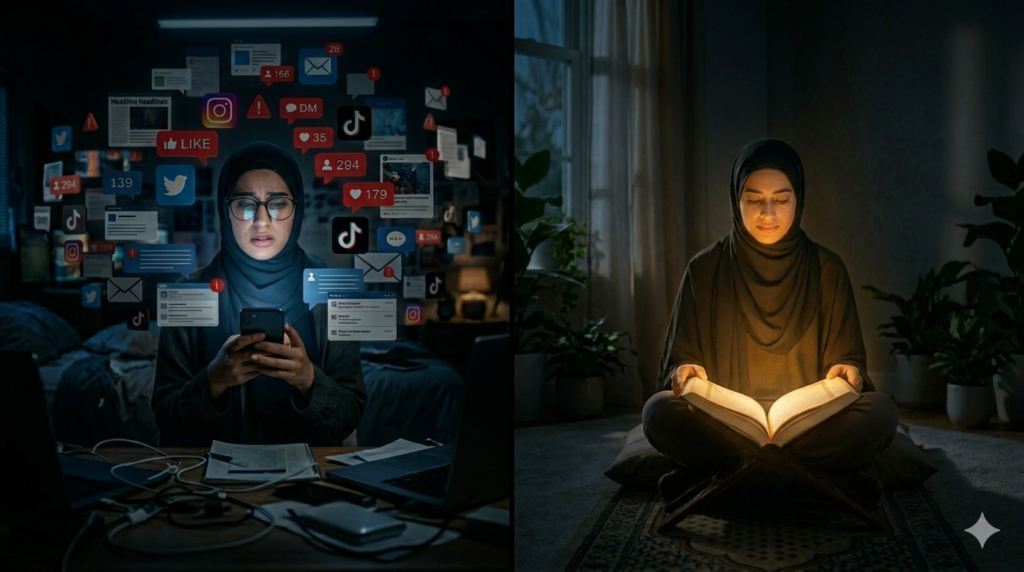
“Take benefit of five before five: your youth before your old age, your health before your sickness, your wealth before your poverty, your free time before your preoccupation, and your life before your death.”
— Prophet Muhammad ﷺ (al-Haakim)
Scroll. Like. Watch. Repeat. The average Muslim today spends 6–7 hours a day on screens — often without noticing. Social media, streaming, messaging, and news cycles pull us into a world that was designed to be addictive. And yet, the framework to reclaim our time and attention has existed in the Sunnah for over 1,400 years.
Digital wellbeing is not a modern concept dressed in self-help language. It is, at its core, a question of amanah — the trust we’ve been given over our time, our minds, and our bodies. And the Prophet ﷺ addressed all three.
We live in a world that competes for our attention every second. Here’s what Islam has taught us about balance — long before smartphones existed.
1. The Sunnah of Intentional Time: Niyyah Before You Open an App
Every action in Islam begins with intention. The Prophet ﷺ said, “Actions are by intentions.” Before you unlock your phone, ask: what is my niyyah right now? Mindless scrolling has no niyyah. It is time consumed without purpose. The Sunnah teaches us that even small actions — eating, sleeping, greeting — carry value when done with intention. Apply the same to your digital life.
Practical step: Set a one-line intention before opening any app. “I’m checking WhatsApp to reply to family.” “I’m watching this lecture to learn.” Purposeless time online is wasted time — and the Prophet ﷺ warned us about that.
“There are two blessings which many people lose: health and free time for doing good.”
— Prophet Muhammad ﷺ (Sahih al-Bukhari)
2. The Sunnah of Rest: Why Sleep Is an Act of Worship
The Prophet ﷺ discouraged staying up late without need, and he slept early after Isha. Today, the biggest thief of sleep is not exhaustion — it’s the glow of a screen. Blue light, endless content, and notification anxiety disrupt the very sleep cycle that Allah built into our fitra.
Sleeping is not laziness — it is an act of trust in Allah’s provision. When we sacrifice sleep for screens, we pay with our health, our focus in Salah, and our emotional resilience. The Sunnah had a “digital curfew” built in long before we needed one.
3. The Sunnah of Boundaries: Protecting What Enters Your Eyes and Ears
Allah says in the Quran: “Tell the believing men to lower their gaze…” (Surah An-Nur 24:30). This ayah is the foundation of Islamic media literacy. Every scroll is a choice about what we let into our hearts. Algorithms are not neutral — they are designed to keep you watching, often at the cost of what is pure, uplifting, or true.
The Sunnah of guarding the gaze translates directly to curating your digital environment: who you follow, what you watch, which groups you’re part of. Your feed is your mental diet. Curate it as carefully as you would your food.
4. Sunnah-Inspired Digital Habits to Start This Week
Phone-free Tahajjud time
Keep the last 30 mins before Fajr screen-free. Let your first words be to Allah, not a notification.
Dhikr instead of doom-scrolling
Replace idle scrolling with SubhanAllah × 33. Your thumbs were made for more than timelines.
Salah as a screen break
Let each of the 5 prayers be a full digital detox. Phone down, presence up.
One Quran verse per notification session
Before opening social media, read one ayah. Anchor your heart before the noise begins.
Prioritise real salam over digital likes
One real conversation holds more barakah than a hundred likes. Invest in the people in front of you.
Reflect before you post
"Whoever believes in Allah and the Last Day, let him speak good or remain silent." — Bukhari
5. Islamic Learning as an Antidote to Digital Emptiness
One of the deepest reasons people lose hours to screens is emptiness — a craving for connection, meaning, or stimulation that social media promises but never fully delivers. The antidote the Sunnah offers is ilm: knowledge. Seeking knowledge is an act of worship. It fills the heart in a way that no algorithm can.
When your screen time is spent learning — Quran, tafsir, fiqh, Arabic, Islamic history — it becomes time that earns you reward instead of taking it away. This is where intentional Islamic education changes everything.

0 Comments