
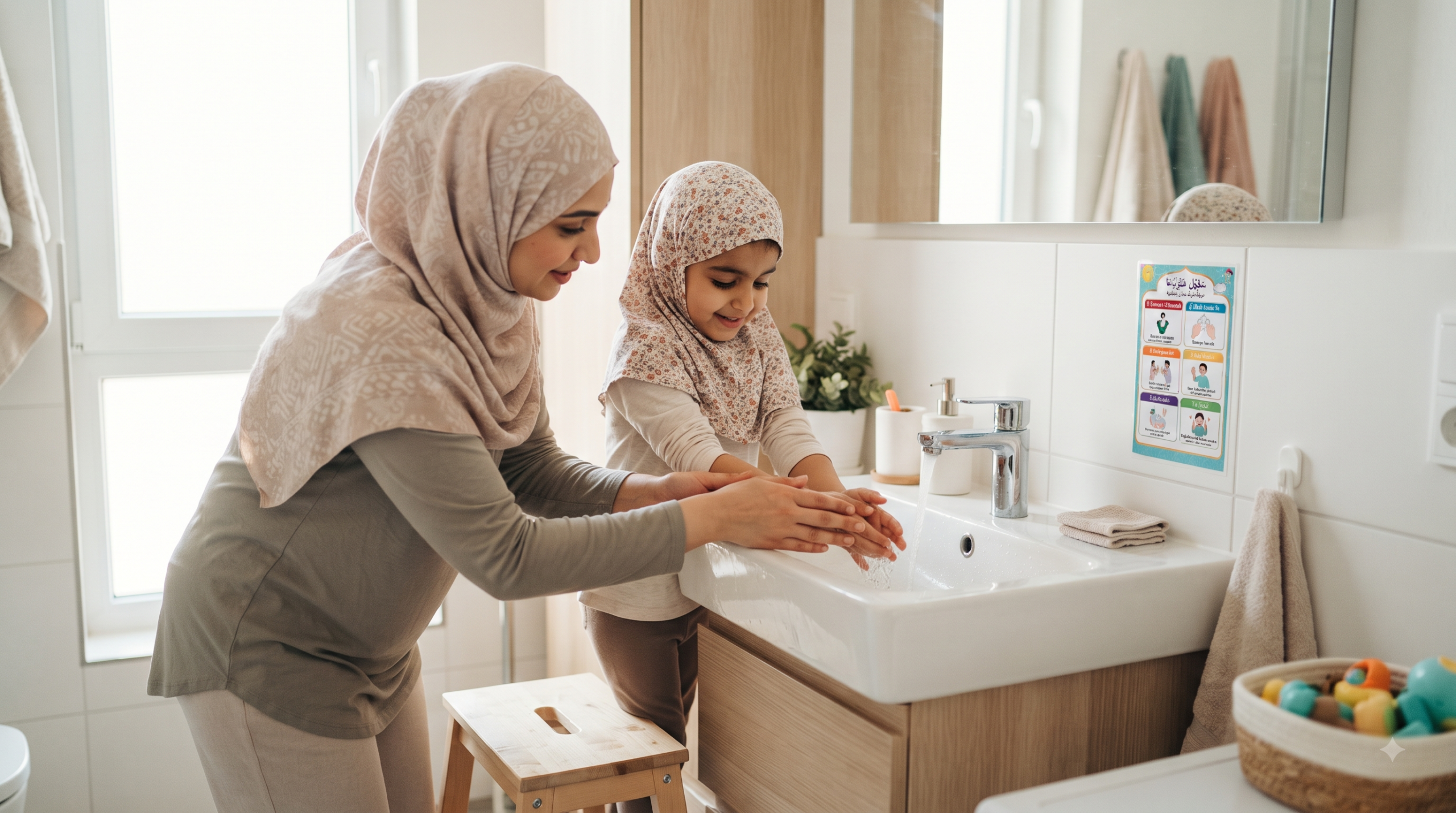



Raising a child who chooses good doesn’t start with rules — it starts with Islamic learning rooted in love for Allah.
Every parent eventually faces the same question: how do I teach my child right from wrong in a way that actually lasts? Threats and punishments might change behavior for a moment, but they rarely shape a child’s heart. What lasts is Islamic learning that helps a child understand why something is good or harmful — not just that it is allowed or forbidden.
In Islam, right and wrong are never arbitrary. They are rooted in the pleasure of Allah, the wellbeing of others, and the health of one’s own heart. When children grasp this connection early, their sense of right and wrong grows from something internal and lasting, not something imposed from outside.
Why Islamic Learning Should Come Before Rules
It is tempting to simply tell a child “this is haram” or “this is not allowed” and expect that to be enough. But children — especially as they grow older — begin to ask why. Islamic learning that explains the wisdom (hikmah) behind a ruling gives children something rules alone cannot: understanding they can carry with them when no one is watching.
“And We did not send any messenger except [to teach] in the language of his people to make things clear for them.” — Surah Ibrahim, 14:4
Just as the Prophets (peace be upon them) taught with clarity suited to their people, our teaching at home should be clear and age-appropriate — never just a list of dos and don’ts, but a growing understanding of why Allah loves certain actions and dislikes others.
Ground Every Lesson in Allah’s Love, Not Just Fear
A child who only learns to avoid wrong out of fear of punishment may stop misbehaving when watched — but may not develop true taqwa (God-consciousness). Islamic learning that also emphasizes Allah’s mercy, love, and closeness helps children want to do good, not merely avoid getting caught doing wrong.
- Talk about Allah’s mercy as often as His justice
- Praise good choices as acts of love for Allah, not just obedience
- Explain consequences gently, connecting actions to their real effects on others
- Use stories of the Prophets to show right and wrong lived out, not just stated
Everyday Moments Are Islamic Learning Opportunities
You do not need a formal lesson every time a moral question comes up. Some of the richest Islamic learning happens in ordinary moments — a sibling disagreement, a small lie, a moment of kindness at school. These are the moments where a short, honest conversation does more than any lecture.
- When your child is unkind: talk about how the Prophet (peace be upon him) treated even those who wronged him
- When your child is honest despite a mistake: praise the honesty specifically, not just the outcome
- When your child asks “why can’t I…”: explain the wisdom, not just the rule
- When your child sees wrong done to someone else: ask them what they think Allah would want them to do
Age-Appropriate Ways to Teach Right and Wrong
Young Children (4–7)
Keep it concrete and story-based. Simple phrases like “Allah loves when we share” or “Allah is happy when we tell the truth” connect actions directly to Allah’s love, without overwhelming detail.
Middle Childhood (8–11)
Children at this age can understand cause and effect more deeply. Introduce the idea of intention (niyyah) — that Allah looks at the heart behind an action, not just the action itself.
Preteens and Older (12+)
Older children are ready for nuance — discussing why something is discouraged rather than forbidden, or how different situations may call for different responses, all while staying grounded in Islamic principles.
A Foundation, Not a Finish Line
Teaching right and wrong Islamically is not a single conversation — it is a foundation built gradually, through consistent Islamic learning woven into daily life. Every honest answer to a hard question, every story shared with intention, adds another layer to a moral compass that will guide your child long after they’ve outgrown needing you to remind them.
The goal is not a child who simply avoids wrong — it is a child whose heart has learned to love what Allah loves.
A Word to Parents Who Don’t Know Where to Start
You don’t need a full curriculum to begin. Choose one thing — one honest conversation, one story about a Prophet’s character, one moment to say “this is what Allah loves” — and return to it. A single lesson, taught with love, is enough to plant a seed. And seeds planted early, revisited again and again as your child grows, become the roots of a moral compass that holds through everything.
Why Families Choose Meem Academia
- Child-Focused Teaching — Lessons paced and styled for each child’s age and understanding
- Structured Islamic Studies Curriculum — Seerah, prophetic history, and Islamic values taught progressively
- Meaningful, Not Just Memorised — Every lesson is connected to a value your child can carry into daily life
- Flexible Online Learning — Live one-on-one sessions scheduled around school and family life
- Regular Parent Updates — Stay informed and involved throughout your child’s journey
- All Ages and Levels Welcome — From early learners to advanced students
Our Programs Include
- Islamic Studies for Children and Adults
- Seerah and Prophetic History
- Quran Recitation with Tajweed
- Quran Memorisation (Hifz)

0 Comments