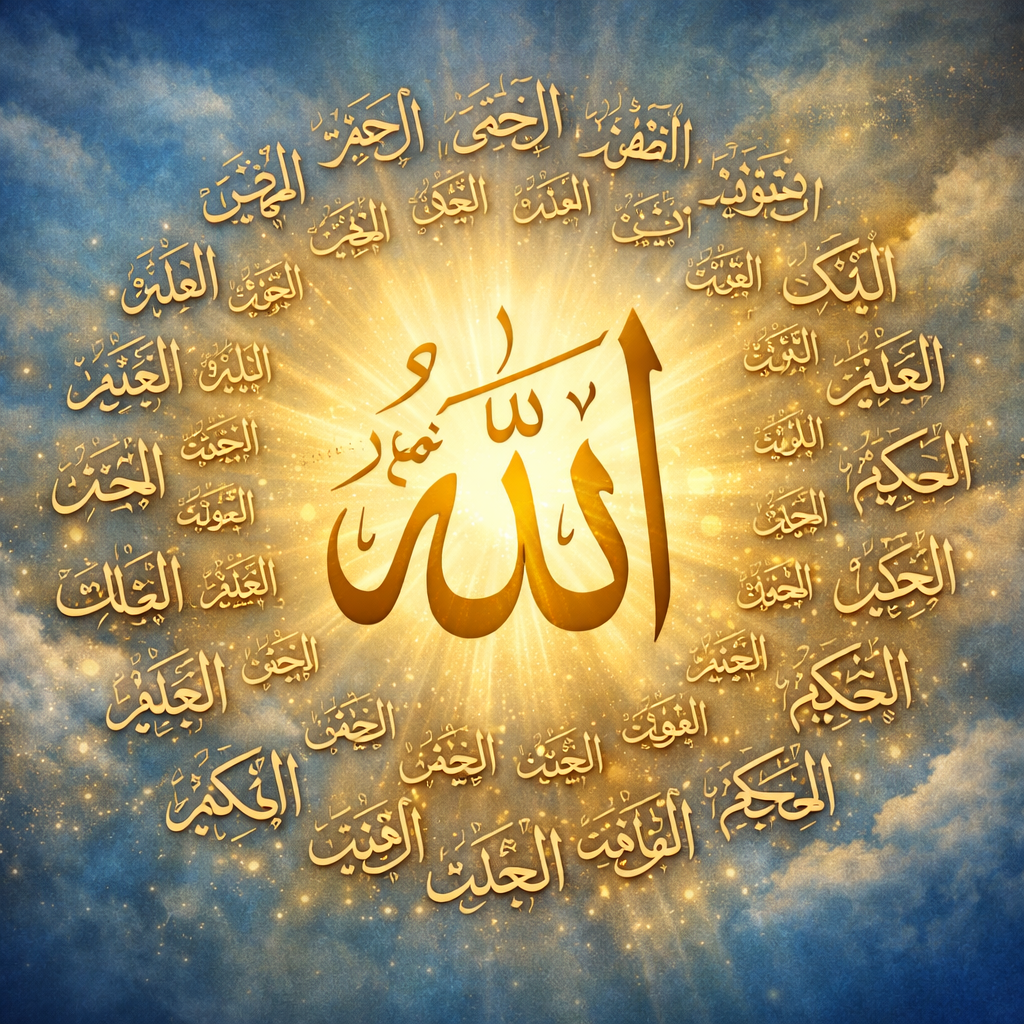
1. Who is Allah in Islam?
Allah is the One and only God in Islam—the Creator of the heavens and the earth. Muslims believe He has no partners, no children, and no equals. As mentioned in the Qur’an, Allah is unique and incomparable.
2. Is Allah the same God worshipped by earlier prophets?
Yes. Muslims believe Allah is the same One God worshipped by earlier prophets such as Adam, Nuh (Noah), Ibrahim (Abraham), Musa (Moses), and ‘Isa (Jesus), peace be upon them all. Islam teaches the continuation of the same message of monotheism delivered through Prophet Muhammad.
3. What are the 99 Names of Allah?
The 99 Names of Allah (Asma’ul Husna) are His beautiful names that describe His perfect attributes, such as Ar-Rahman (The Most Merciful), Al-‘Aleem (The All-Knowing), and Al-Hakeem (The Most Wise). Each name helps believers understand Allah’s greatness and mercy more deeply.
4. Why is it important to learn the names and attributes of Allah?
Learning Allah’s names strengthens faith, increases trust in Him, and improves daily character. For example, when we understand that Allah is Al-Ghafoor (The Most Forgiving), we never lose hope in His mercy. Therefore, knowledge of His names brings both spiritual growth and inner peace.
5. Can we fully understand Allah’s attributes?
Humans cannot fully comprehend Allah’s essence. However, we understand what He has revealed about Himself in the Qur’an and authentic teachings. At the same time, Muslims believe that “There is nothing like unto Him.”
6. How can I start learning about Allah’s names?
You can begin by:
Memorizing a few names at a time
Learning their meanings and practical applications
Reflecting on them in daily prayers
Studying under qualified Islamic teachers
Structured programs, such as MeeM courses, provide guided and authentic learning to help students understand Allah’s names correctly.