



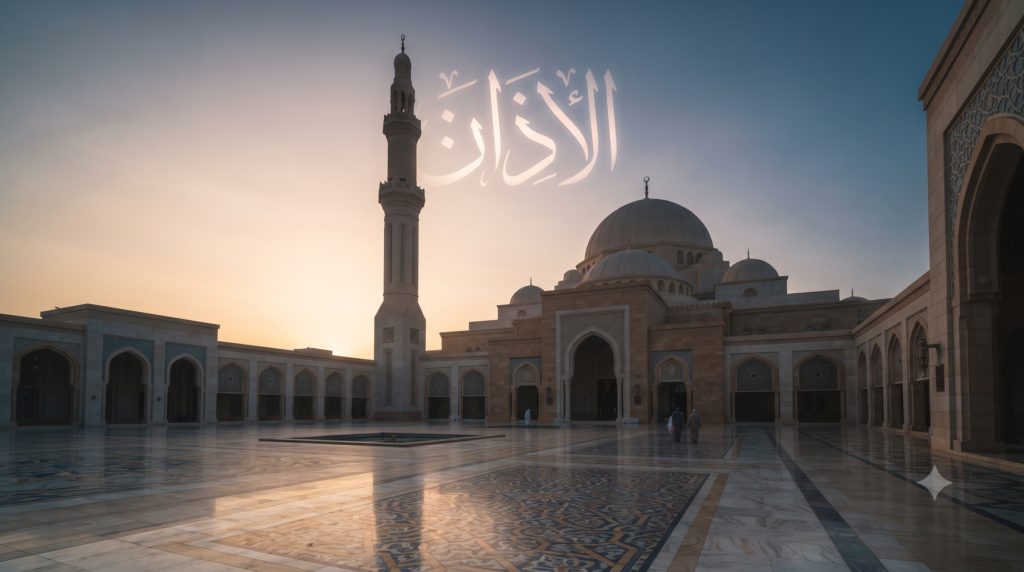
Five Times a Day, the World Is Called Back to What Matters
You’re in the middle of something — a meeting, a meal, a moment of worry — and then it comes.
The azan.
For some, it’s a sound woven so deeply into memory that it stops them mid-breath. For others, it’s the first call they ever heard — whispered into their ear moments after birth, before they could understand a single word of it. For others still, it’s the sound they associate most closely with home, with belonging, with something that is theirs in a way they find hard to articulate.
The azan is more than an announcement. It is an invitation — one of the oldest, most repeated invitations in human history. This blog is about what that invitation says, what it means, and why — even after a lifetime of hearing it — it still has the power to move us.
What Is the Azan?
The azan — also spelled adhan — is the Islamic call to prayer, sounded five times daily to announce the time for each of the obligatory prayers. It was established in the first years of Islam in Madinah, when the Prophet ⺨ sought a way to call the Muslim community to prayer. The honour of being the first muezzin — the one who calls the azan — was given to Bilal ibn Rabah (رضي الله عنه), a formerly enslaved man chosen for the beauty and power of his voice.
That choice — of Bilal — carries its own message. The azan has never belonged only to the powerful or the privileged. It belongs to every Muslim who hears it, wherever they are in the world.
The azan has been sounded continuously somewhere on earth for over 1,400 years. As the earth rotates and prayer times move around the globe, the call has never stopped.
The Words of the Azan — And What They Mean
The azan is not simply a time announcement. Every phrase is a declaration, an invitation, and a reminder. Here is what is being said — and what it means:
اللهُ أكبَر
Allahu Akbar — Allah is the Greatest (repeated 4 times)
The azan opens not with a request, but with a proclamation. Whatever you are doing, wherever your attention has wandered — Allah is greater than all of it. Greater than the deadline, the distraction, the worry, the joy. This single phrase, repeated four times, is a reorientation before a single step toward prayer is taken.
أشهدُ أن لا إلهَ إلّا الله
Ashhadu an la ilaha illallah — I bear witness that there is no god but Allah (twice)
This is the first half of the shahada — the declaration of faith — embedded into the heart of every azan. Five times a day, the Muslim world collectively re-witnesses its central truth: that nothing is worthy of worship except Allah.
أشهدُ أنّ محمّدًا رسولُ الله
Ashhadu anna Muhammadan rasulullah — I bear witness that Muhammad is the Messenger of Allah (twice)
The second half of the shahada follows immediately — affirming not just the existence of Allah, but the messenger He sent. The azan ties belief in Allah inseparably to the Prophet ⺨ and the guidance he brought.
حَيَّ على الصَّلاة
Hayya ‘alas-salah — Come to prayer (twice)
The azan now becomes a direct address. Not a statement about Allah, but a call to the listener: come. Leave what you are doing. Come to something better. This phrase is considered the pivot of the azan — where proclamation becomes invitation.
حَيَّ على الفَلاح
Hayya ‘alal-falah — Come to success (twice)
This phrase reframes what success means. Not wealth, status, or productivity — but prayer. The azan is quietly radical in this: five times a day, it insists that the most successful thing a person can do with this moment is to come and stand before Allah.
اللهُ أكبَر اللهُ أكبَر
Allahu Akbar, Allahu Akbar — Allah is the Greatest, Allah is the Greatest
The azan closes as it opened — with the greatness of Allah. What began as a proclamation ends as a reminder: the call has been given, the invitation extended. What comes next is a choice.
لا إلهَ إلّا الله
La ilaha illallah — There is no god but Allah
The final phrase distils everything into its simplest form. One God. That is the azan — from its opening to its close.
The Sunnah of Responding to the Azan
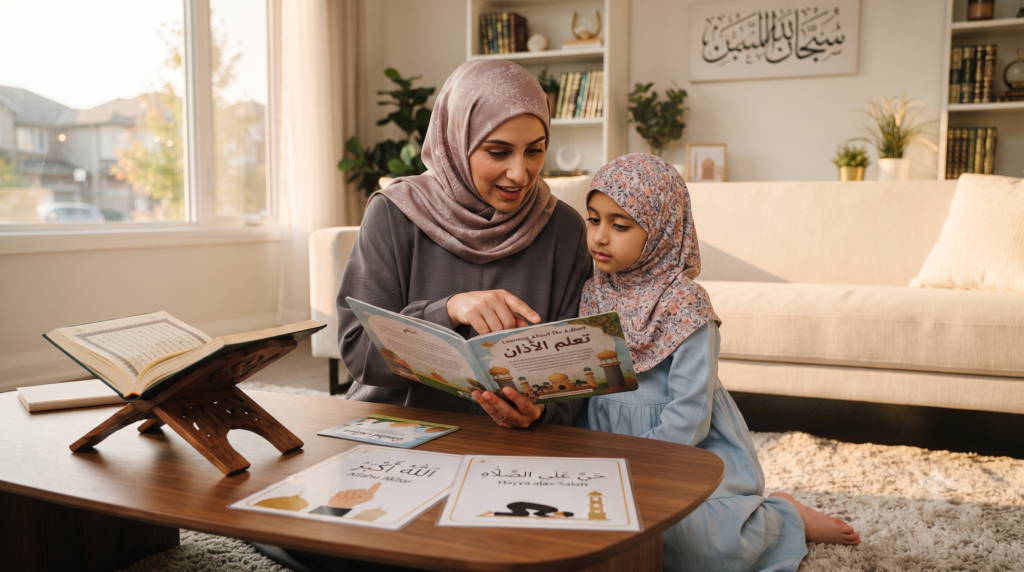
Hearing the azan is not meant to be passive. The Prophet ⺨ taught that when the azan is called, the listener repeats each phrase after the muezzin — responding to the call as well as receiving it. When Hayya ‘alas-salah and Hayya ‘alal-falah are called, the response is: La hawla wala quwwata illa billah — there is no power or strength except with Allah.
After the azan, a du’a is recommended — asking Allah to grant the Prophet ⺨ the highest station and intercession. The Prophet ⺨ promised that whoever does this, his intercession will be guaranteed for them on the Day of Resurrection.
The Prophet ⺨ said: “Du’a is not rejected between the azan and the iqamah, so ask Allah for what you need.” — Sunan Abi Dawud 521 (Hasan)
Why the Azan Still Moves Us
There are sounds that carry weight beyond their words. The azan is one of them.
Part of it is memory — the way the sound is tied, for most Muslims, to earliest childhood, to the feeling of safe spaces and familiar voices. Part of it is repetition — a phrase heard thousands of times across a lifetime carries something a new phrase never can. And part of it is meaning — that these words, every single time, are saying something true about the world: that Allah is greatest, that prayer is the path to success, that five times a day the world is invited to pause and remember.
However far a Muslim has travelled from their faith, however long the distance between one prayer and the next — the azan tends to find them. It was designed to.
Teaching Children to Love the Azan
- Pause when it sounds, even briefly. Children notice what adults stop for. If the azan calls and life simply continues around it, it signals that it is background noise. If a parent pauses, the child learns it matters.
- Teach the response du’a early. Even a child who doesn’t yet understand the words can learn to repeat after the azan — and that habit, formed early, tends to stay.
- Tell the story of Bilal (رضي الله عنه). The first muezzin’s story — of a man chosen for his voice and his faith, not his status — gives the azan a human face children connect with.
- Explain one phrase at a time. Rather than a full translation all at once, introduce one line of the azan and its meaning per week until your child knows what they are hearing.
- Let the azan mark the rhythm of the day. When the azan becomes the natural signal for prayer time rather than a parent’s reminder, children begin to feel the shape of a day structured around worship.
Why Families Choose Meem Academia:
- 👶 Child-Focused Teaching — Lessons paced and styled for each child’s age and understanding
- 📖 Structured Islamic Studies Curriculum — Salah, azan, worship, and daily Islamic practice taught progressively
- 🕌 Meaningful, Not Just Memorised — Every lesson is connected to a value your child can carry into daily life
- 🌍 Flexible Online Learning — Live one-on-one sessions scheduled around school and family life
- 👨👩👧 Regular Parent Updates — Stay informed and involved throughout your child’s journey
- 🎓 All Ages and Levels Welcome — From early learners to advanced students
Our Programs Include:
- Islamic Studies for Children and Adults
- Quran Recitation with Tajweed
- Seerah and Prophetic History
- Quran Memorisation (Hifz)
🌟 Help Your Child Hear the Azan With Their Heart, Not Just Their Ears
Understanding changes everything. When a child knows what the azan is saying, it stops being background and becomes a call they feel.
Enroll at Meem Academia Today → meemacademia.com
Book a free trial class. Meet your child’s teacher. Watch their love for their faith come alive.
“When the call to prayer is made, the doors of heaven are opened.” — Sahih al-Bukhari 1145

0 Comments