


The First Skill Before Salah — and Often the Most Rushed
Before a child ever stands for their first prayer, there’s a quieter skill they need to master first: wudu.
It seems simple to adults who’ve done it thousands of times, but for a child, wudu involves remembering a sequence, getting the order right, and not skipping steps when the water is cold or they’re in a hurry to go play.
Here’s the good news: wudu is one of the easiest parts of worship to teach well, because it’s hands-on, repeatable, and easy to turn into a simple step-by-step habit — especially with a visual checklist to guide them.
This blog breaks wudu down into clear steps for kids, along with practical tips to help it stick — plus a printable checklist you can post right by the sink.
Why Children Struggle With Wudu at First
- The sequence is easy to forget. Seven steps in a specific order is a lot for a young child to hold in memory without repetition.
- It feels rushed. Children often treat wudu as something to get through quickly rather than an act of worship in itself.
- Some steps get skipped. Ears, between the toes, and the back of the neck are commonly missed without a visual reminder.
Wudu for Kids: Step-by-Step Guide
- Make the Intention (Niyyah). Quietly intend in the heart to perform wudu for the sake of Allah — no specific words required, just a simple thought.
- Say Bismillah. Begin by saying “Bismillah” (In the name of Allah) before starting.
- Wash the Hands. Wash both hands up to the wrists three times, making sure water reaches between the fingers.
- Rinse the Mouth. Take water into the mouth and rinse it around three times.
- Rinse the Nose. Sniff water gently into the nose and blow it out, three times.
- Wash the Face. Wash the entire face from forehead to chin, ear to ear, three times.
- Wash the Arms. Wash each arm up to the elbow, starting with the right, three times each.
- Wipe the Head. Wipe wet hands over the head once, from front to back.
- Wipe the Ears. Use wet fingers to wipe the inside and outside of both ears.
- Wash the Feet. Wash each foot up to the ankle, starting with the right, making sure to clean between the toes, three times each.
Making Wudu a Habit, Not a Hassle
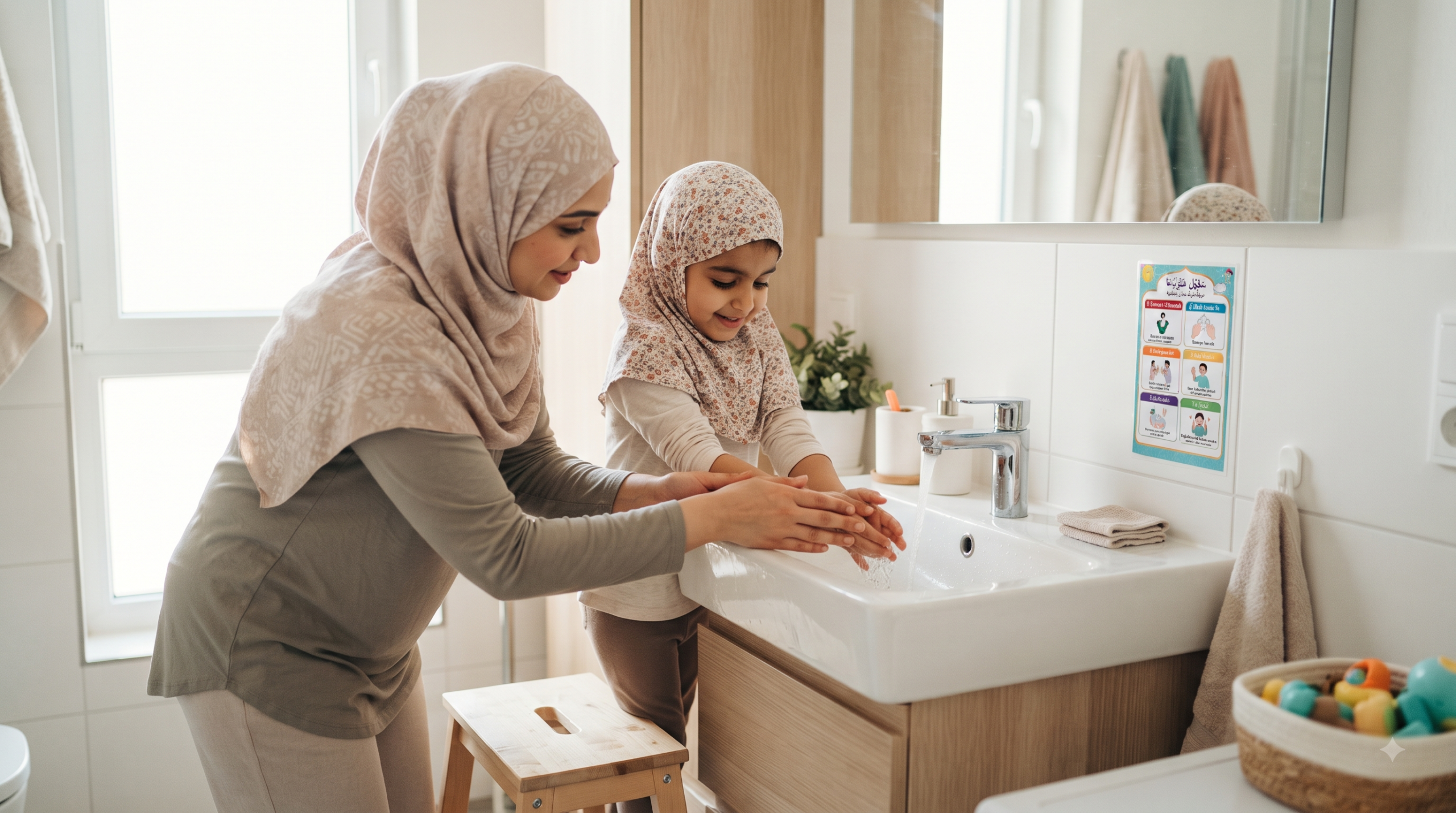
- Print a simple step chart for the bathroom. A visual checklist by the sink reminds children of the order without you having to repeat it every time.
- Use a step-counting game. Counting out loud together (“one, two, three!”) for each wash keeps younger children engaged and on track.
- Demonstrate alongside them. Performing wudu side by side, especially in the early weeks, helps children copy the correct technique naturally.
- Talk about why it matters. Explain simply that wudu is how we get clean and ready to stand before Allah — helping it feel meaningful, not just procedural.
- Be patient with mistakes. Missed spots or skipped steps are part of learning — gentle correction works far better than frustration.
- Celebrate consistency. Praise a child for remembering all the steps correctly, not just for finishing quickly.
A Simple Printable Checklist You Can Use
Post this short list near the sink as a quick visual reminder for your child:
- ✅ Niyyah (intend in the heart)
- ✅ Say Bismillah
- ✅ Wash hands (x3)
- ✅ Rinse mouth (x3)
- ✅ Rinse nose (x3)
- ✅ Wash face (x3)
- ✅ Wash arms to elbows (x3 each)
- ✅ Wipe head (x1)
- ✅ Wipe ears (x1)
- ✅ Wash feet to ankles (x3 each)
A Word to Parents Teaching This for the First Time
It’s completely normal for a child to need many repetitions before wudu becomes automatic. What matters is steady, patient practice — not getting it perfect on day one.
Each time your child completes their wudu correctly, they’re not just learning a physical sequence — they’re building the foundation for a lifetime of prayer.
📚 Build Strong Worship Habits With Meem Academia
At Meem Academia, we believe even the smallest acts of worship, like wudu, deserve patient, structured teaching. Learning that fits for future.
We are not just another Islamic studies platform. We are a community of educators who help children build the full foundation of worship — from wudu to salah — step by step, with care.
Why Families Choose Meem Academia:
- 👶 Child-Focused Teaching — Lessons paced and styled for each child’s age and understanding
- 📖 Structured Islamic Studies Curriculum — Wudu, salah, and daily worship taught progressively
- 🕌 Meaningful, Not Just Memorised — Every lesson is connected to a value your child can carry into daily life
- 🌍 Flexible Online Learning — Live one-on-one sessions scheduled around school and family life
- 👨👩👧 Regular Parent Updates — Stay informed and involved throughout your child’s journey
- 🎓 All Ages and Levels Welcome — From early learners to advanced students
Our Programs Include:
- Islamic Studies for Children and Adults
- Quran Recitation with Tajweed
- Seerah and Prophetic History
- Quran Memorisation (Hifz)
🌟 Help Your Child Build the Full Foundation of Prayer
Wudu is the first step toward a lifetime of salah — with the right guidance, your child can build this habit with confidence.
Enroll at Meem Academia Today → meemacademia.com
Book a free trial class. Meet your child’s teacher. Watch their love for their faith come alive.

0 Comments